
China Isn’t Just Threatening Taiwan — It’s Trying to Steal the Future of Chips
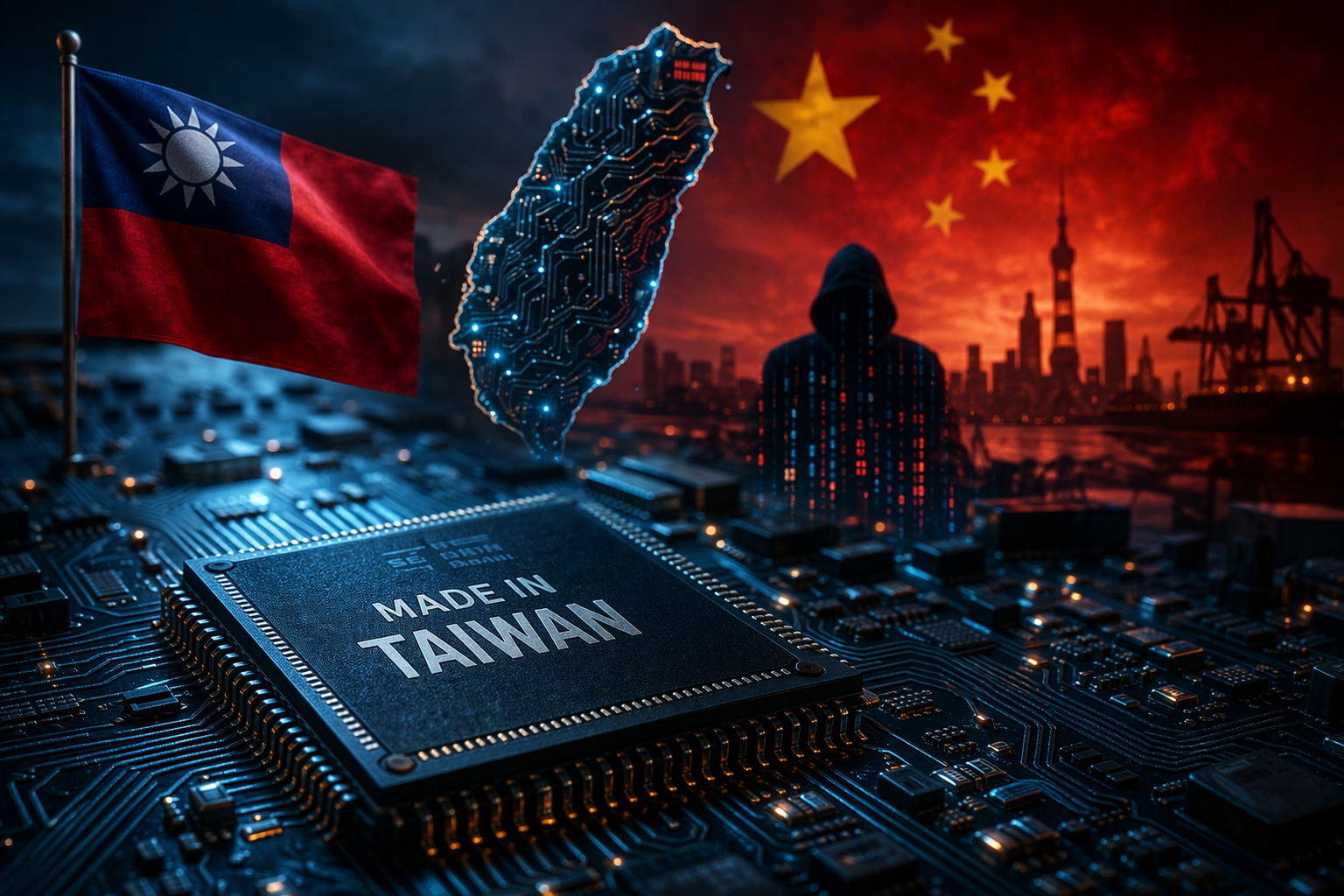
The Real Battle Over Taiwan Isn’t Military — It’s Technological
Taiwan Warns: China Is Quietly Targeting Its Most Valuable Asset
Taipei says Beijing is intensifying efforts to extract talent, technology, and leverage from the world’s most critical semiconductor hub—and the implications stretch far beyond Taiwan.
This is not about invasion — ’s about infiltration
For years, the world has framed Taiwan as a potential flashpoint for military conflict.
But Taiwan’s latest warning reframes the threat entirely.
According to its top security agency, China is not simply posturing militarily — it is systematically targeting Taiwan’s semiconductor dominance through talent poaching, technology acquisition, and covert economic pressure.
That is a completely unique kind of conflict.
Slower. Quieter. And potentially far more effective.
The real prize: control of the global system
Taiwan is not just another economy. It sits at the center of the modern world’s most critical supply chain.
Its companies — especially TSMC — produce the most advanced chips on Earth. These are the components that power
AI systems
smartphones
defence technologies
cloud infrastructure
global financial systems
Taiwan produces the majority of the world’s advanced semiconductors, with near-total dominance at the cutting edge.
This is why analysts call it the “silicon shield.”
Not because it protects Taiwan militarily, but because the world depends on it too much to let it fall.
China understands the situation.
And it doesn’t need to invade to weaken its advantage.
How China is actually targeting Taiwan
Taipei’s assessment is blunt.
China is using indirect, hybrid methods to access Taiwan’s chip ecosystem:
Recruiting engineers through front companies and shell entities
Offering incentives to relocate talent to mainland firms
Attempting to acquire restricted semiconductor equipment and knowledge
Using cyber intrusions and intelligence gathering to extract sensitive data
This scenario is not theoretical.
Taiwan has already launched investigations into multiple Chinese-linked firms accused of illegally poaching semiconductor talent.
And cyberattacks targeting the sector have surged.
The message is clear: China is not waiting for technological parity — it is trying to accelerate it by absorbing Taiwan’s expertise.
Why this is happening now
Because China is stuck.
Despite years of massive investment, it still lags far behind in advanced chip manufacturing.
Its semiconductor self-sufficiency remains low, and it remains heavily dependent on foreign technology — particularly from Taiwan and Western-aligned supply chains.
At the same time, U.S.-led export controls have tightened access to the following:
advanced chips
chipmaking equipment
technical expertise
This approach is what Taipei refers to as “containment.”
China’s response is not just to build but to extract.
What media misses
What most coverage still gets wrong is treating the situation as a precursor to war.
It could be the alternative to war.
If China can:
pull Taiwanese talent into its ecosystem
replicate key manufacturing capabilities
weaken Taiwan’s technological edge
Then the strategic equation changes—without a single shot fired.
This is not escalation in the traditional sense.
It is substitution.
A shift from military confrontation to system-level absorption.
The deeper strategic logic
There are three layers to what’s happening:
1. Economic survival
Semiconductors are now the foundation of modern economies. China cannot afford long-term dependence.
2. Technological sovereignty
Control of chips means control of AI, defense systems, and industrial capacity.
3. Geopolitical leverage
If China closes the gap with Taiwan, it reduces Western influence over global tech supply chains.
In other words:
This is not about catching up.
It’s about rewriting the balance of power.
The hidden contradiction
There is an uncomfortable reality at the heart of this story.
The same global dependence that protects Taiwan also makes it vulnerable.
Because the more valuable its semiconductor industry becomes,
the more aggressively it is targeted
the harder it is to fully secure
the more incentives exist to quietly extract its advantage
Taiwan’s strength is also its exposure.
What happens next
Three trajectories now matter:
Most likely
China continues expanding indirect access—talent, partnerships, and grey-zone activity—while avoiding overt escalation.
Most dangerous
A successful erosion of Taiwan’s technological lead reduces deterrence and increases geopolitical instability.
Most underestimated
A gradual shift where China doesn’t dominate chips but becomes “adequate enough” to break Western leverage.
That alone would reshape global power.
The bigger shift underway
The semiconductor war is no longer just about factories and supply chains.
It is about:
people
knowledge
systems
quiet influence
And those are much harder to defend.
The real takeaway
The world keeps asking whether China will take Taiwan.
But the more important question is this:
What if it doesn’t need to?
