
True Crime: 9/11 and the Morning the Sky Turned Against America
9/11 and the Architecture of Catastrophe
The Two Hours That Changed the Modern World
A Morning So Ordinary It Still Hurts
The cruelty of 9/11 begins with how unexceptional the opening minutes were. Four transcontinental flights left the East Coast for California. Office workers moved into the World Trade Center complex. Military and civilian employees reported to the Pentagon. On Flight 93, there were 33 passengers and seven crew members, ranging in age from 20 to 79. The day had not yet declared itself.
That ordinariness matters because it keeps the dead from becoming abstraction. The victims were not one category of person. They were flight attendants, pilots, bond traders, receptionists, restaurant workers, firefighters, police officers, military personnel, visitors, and children. The memorial record notes that eight children were killed on 9/11, all aboard the aircraft. At the Pentagon memorial, the age line runs from a three-year-old child to a seventy-one-year-old veteran.
What happened next did not erase that human texture. It sharpened it. The case became historically vast, but it remained, at its core, a collection of interrupted private lives. That is why the annual commemorations still center the names.
The Plot That Had Already Entered the Country
The official record established that the attacks were not improvised. The 9/11 Commission concluded that the operation was planned by al-Qaeda and that the plotters used visas, flight training, travel, and routine domestic air travel to move men into position inside the United States. One of the future hijackers, Hani Hanjour, already held a commercial pilot’s license before his final entry into the country.
Pre-9/11 aviation security was built around an older hijacking model. The assumption was that hijacked planes would remain identifiable, that chains of notification would function with time to spare, and that hijackers wanted bargaining leverage, not suicide. Airlines had primary responsibility for screening passengers and baggage; the federal role was regulatory. Those assumptions were not designed for aircraft deliberately turned into guided missiles.
That gap between the threat imagined and the threat executed became one of the defining facts of the case. The plot succeeded not because nothing was known about al-Qaeda, but because the system that morning was poorly matched to the attack that actually arrived.
8:46 in Lower Manhattan
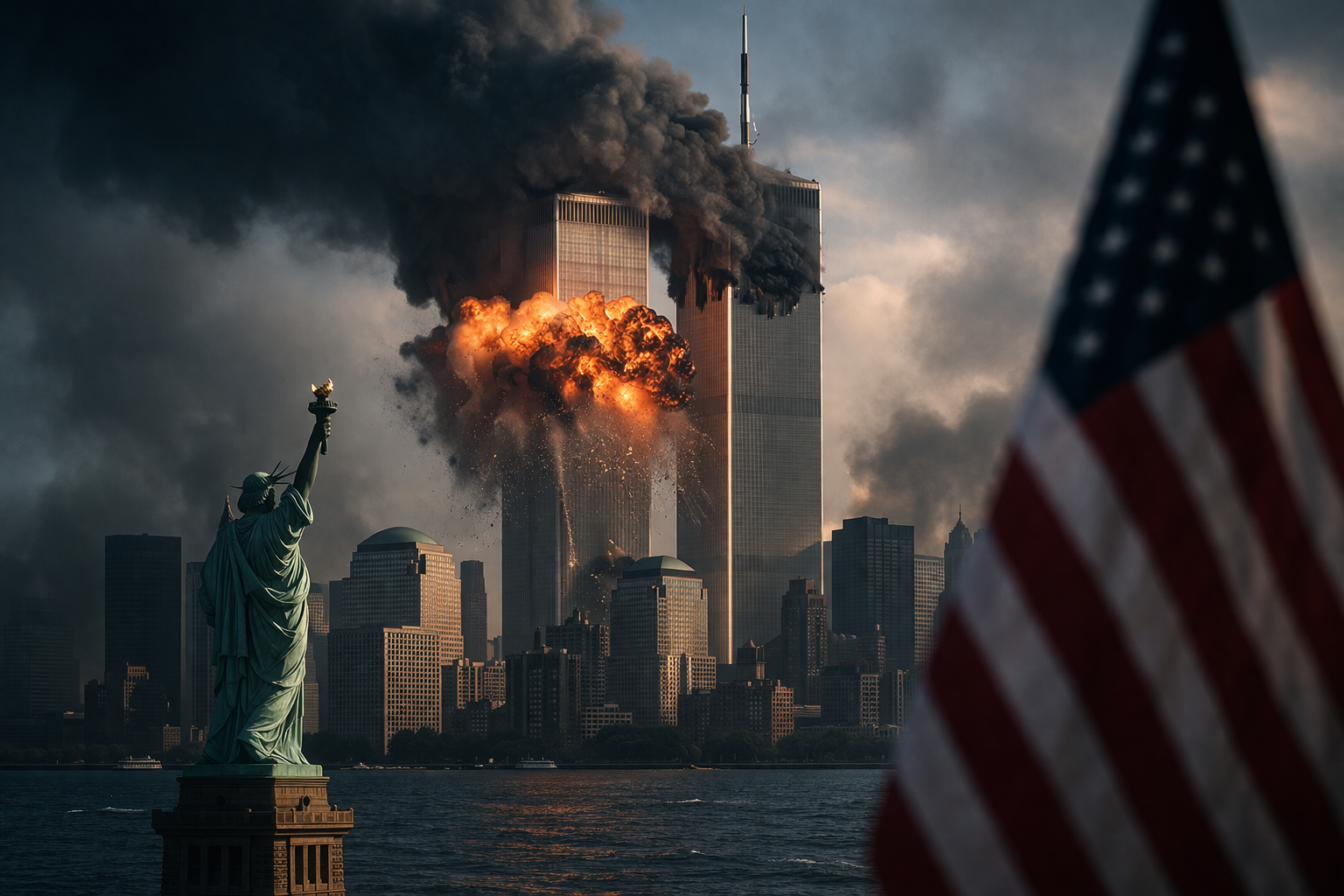
At 8:46 a.m., American Airlines Flight 11 struck the North Tower of the World Trade Center. To many watching from the ground, there was still room for misreading. A crash, yes. A terrible one. But perhaps an accident. That ambiguity lasted only minutes, and even then it was beginning to close inside the building, where occupants above the impact zone faced conditions that would become unsurvivable.
Sixteen minutes later, at 9:02 a.m., United Airlines Flight 175 hit the South Tower. Whatever uncertainty had existed was gone. Two Boeing 767s had struck the Twin Towers in deliberate succession. The attack was no longer a disaster in search of explanation. It was a coordinated act of mass murder unfolding live.
The World Trade Center death toll would eventually reach 2,753. Among the dead were 343 FDNY firefighters, 37 Port Authority police officers, and 23 NYPD officers. In total, 441 first responders from more than 30 agencies died that day, the largest loss of rescue personnel in American history.
The Physics of Fire and Collapse
The South Tower collapsed at 9:59 a.m. The North Tower collapsed at 10:28 a.m. Those times are fixed in the record now, but the reason they matter is not only chronological. They define the narrowing window in which evacuation, rescue, command, and chance all collided. Some people made it out. Thousands did not. Many rescuers were still ascending when the structures failed.
The later technical investigation did not treat the collapses as folklore. It treated them as engineering failures under extreme conditions. NIST concluded that the towers were struck 16 minutes apart and that the crashes dislodged fireproofing, severed structural elements, and ignited fires fed by jet fuel and office contents. In the hours that followed, heat weakened critical components until collapse began.
The same fact-based approach later addressed World Trade Center 7, the 47-story building north of the main complex. NIST concluded that WTC 7 collapsed at 5:20:52 p.m. after enduring fires for nearly seven hours and that fire, not a separate blast event, was the primary cause of its failure. That finding matters because 9/11 has always produced myths around its edges. The official investigations were designed to reduce those edges, not widen them.
9:37 at the Pentagon
At 9:37 a.m., American Airlines Flight 77 struck the Pentagon. The building was not a symbolic target alone. It was a working office complex at the center of the U.S. military establishment, full of people who had begun the day inside routine schedules. The attack killed all 64 people on the plane and 125 people inside the building, for a Pentagon total of 184 dead.
There is a different texture to the Pentagon portion of the case. The violence was compressed into one impact point rather than spread vertically through a skyline. But the result was still intimate and devastating: offices shredded, hallways burning, survivors forcing paths through smoke, rescue workers moving toward a wound in the building that had opened in seconds.
The memorial built there later organized the dead by age and by location, distinguishing those on the aircraft from those inside the Pentagon. It is a small but telling design choice. Even in commemoration, the case is still arranged around position, direction, and final circumstance.
Flight 93 and the Revolt in the Cabin
Flight 93 followed a different arc. According to the National Park Service timeline, the hijackers overtook the cockpit at about 9:28 a.m., forced passengers and crew to the back, and turned the aircraft southeast toward Washington. In the next half hour, people on board made dozens of calls and learned that other hijacked planes had already struck the World Trade Center and the Pentagon.
That knowledge changed the moral geometry inside the cabin. This was no longer, even theoretically, a hijacking that ended on a runway. The passengers and crew understood that the plane itself was the weapon. The Park Service states that they took a vote and decided to fight back. The struggle began at approximately 9:57 a.m. The plane crashed at 10:03 a.m. in Somerset County, Pennsylvania, 18 minutes’ flying time from Washington, according to the memorial record.
Some details of the final struggle remain reconstructed rather than fully witnessed. Reporting from that morning was conflicting, and much of what is known comes from calls, recorder evidence, and later investigation. But the official conclusion is clear on the essential point: the passengers and crew of Flight 93 disrupted the hijackers’ plan and prevented the aircraft from reaching its intended target. The memorial site identifies that target as the U.S. Capitol.
The Dead, the Missing, and the Work of Naming
Mass killing does not end when the public spectacle ends. It moves into identification, notification, recovery, and the long administrative labor of grief. At the World Trade Center, those processes were extraordinarily difficult because of the violence of the impacts, the collapses, the fires, and the destruction at Ground Zero. The New York City medical examiner continues to identify remains years later using advanced DNA analysis.
That continuing work is one of the most important correctives to abstraction. The city announced a new identification in January 2024, describing it as the 1,650th World Trade Center victim identified through the medical examiner’s efforts. In August 2025, city officials announced three more identifications. The repository at bedrock at the World Trade Center site remains under the jurisdiction of the medical examiner for unidentified and unclaimed remains.
The names carved into bronze and read aloud each September are not an ending. They are the visible edge of an identification process that, unlike the attacks themselves, has unfolded over decades.
The Failures the Case Exposed
The 9/11 Commission was created to produce a full account of the circumstances surrounding the attacks, including preparedness and immediate response. Its record made clear that the problem was not one single missed clue. It was a web of intelligence fragmentation, aviation-security assumptions, communication failures, and command systems built for a different kind of hijacking.
That diagnosis shaped the institutional aftermath. Congress later enacted the Implementing Recommendations of the 9/11 Commission Act of 2007. Aviation security was restructured through the Transportation Security Administration, which traces its own history directly to the attacks. The broader intelligence architecture was also reworked in the years after the commission’s findings.
But no reform can erase the central fact. The official record is not comforting. It does not say the state was powerless. It says the state was configured for the wrong nightmare.
Law, War, and the Long Pursuit of Accountability
In one sense, the immediate perpetrators died on 9/11. In another, the case remained open. The FBI describes the attacks as a meticulously planned operation and publicly released the list of 19 identified hijackers soon after. The broader legal pursuit focused on alleged planners, facilitators, and the financial and operational networks behind the plot.
That pursuit has been painfully slow. The 9/11 military commission case tied to Khalid Shaikh Mohammad and other defendants remains active. In November 2024, the Defense Department announced that three defendants had agreed to plead guilty. Yet the Office of Military Commissions’ 2026 calendar and case updates show continued hearings and active litigation. The legal story of 9/11, then, is not one of swift closure. It is one of delay, contest, and a justice process stretched across generations.
That unfinished quality matters. A case this large did not move neatly from crime to trial to verdict. It spilled into war, detention, intelligence reform, and the unresolved question of whether a democratic state can answer a crime of this scale without deforming itself in the process.
The Long Tail of Dust, Illness, and Compensation
The dead were not the only people marked permanently by the attacks. The federal World Trade Center Health Program exists because responders and survivors continued to experience physical and mental health consequences tied to their 9/11 exposure. As of October 2024, the program said it served almost 128,000 members, with more than 81,000 diagnosed with at least one certified WTC-related physical or mental health condition. It is authorized through 2090.
The compensation system also had to become long-term. The September 11th Victim Compensation Fund was created to compensate those physically harmed or killed as a result of the attacks and the debris-removal efforts that followed. That language matters because it recognizes that 9/11 did not end on September 11. Exposure, illness, and loss continued to emerge long after the smoke was gone from television.
Even the FDNY’s memorial language now reflects that extended timeline, honoring not only the 343 firefighters who died that day but also members who later died from World Trade Center-related illnesses. The case did not simply leave widows, parents, and children bereft. It left a second ring of casualties, slower and crueler, measured in diagnoses and funerals years later.
Why 9/11 Still Matters
9/11 still matters because it sits at the intersection of murder, memory, and state power. It was a mass-casualty terrorist crime executed with chilling precision. It was also the beginning of a national and international response whose consequences reached into war, surveillance, immigration, aviation, public health, compensation law, memorial culture, and the daily vocabulary of security.
It still matters because the facts resist simplification. The official investigations established much, but not everything. Some final moments remain partly reconstructed. Some families still waited years for identifications. Some defendants still have not passed through a completed legal ending. Some responders are still getting sick. A crime this large does not become history all at once.
And it still matters because the names are not metaphors. They are the point. Every year, they are read again in lower Manhattan, not to preserve a mood, but to resist scale’s most brutal trick: turning individual human beings into a number that feels easier to carry than the truth.
