
The Surveillance State Is No Longer A Conspiracy Theory — Britain’s Facial Recognition Expansion Has Triggered A National Backlash
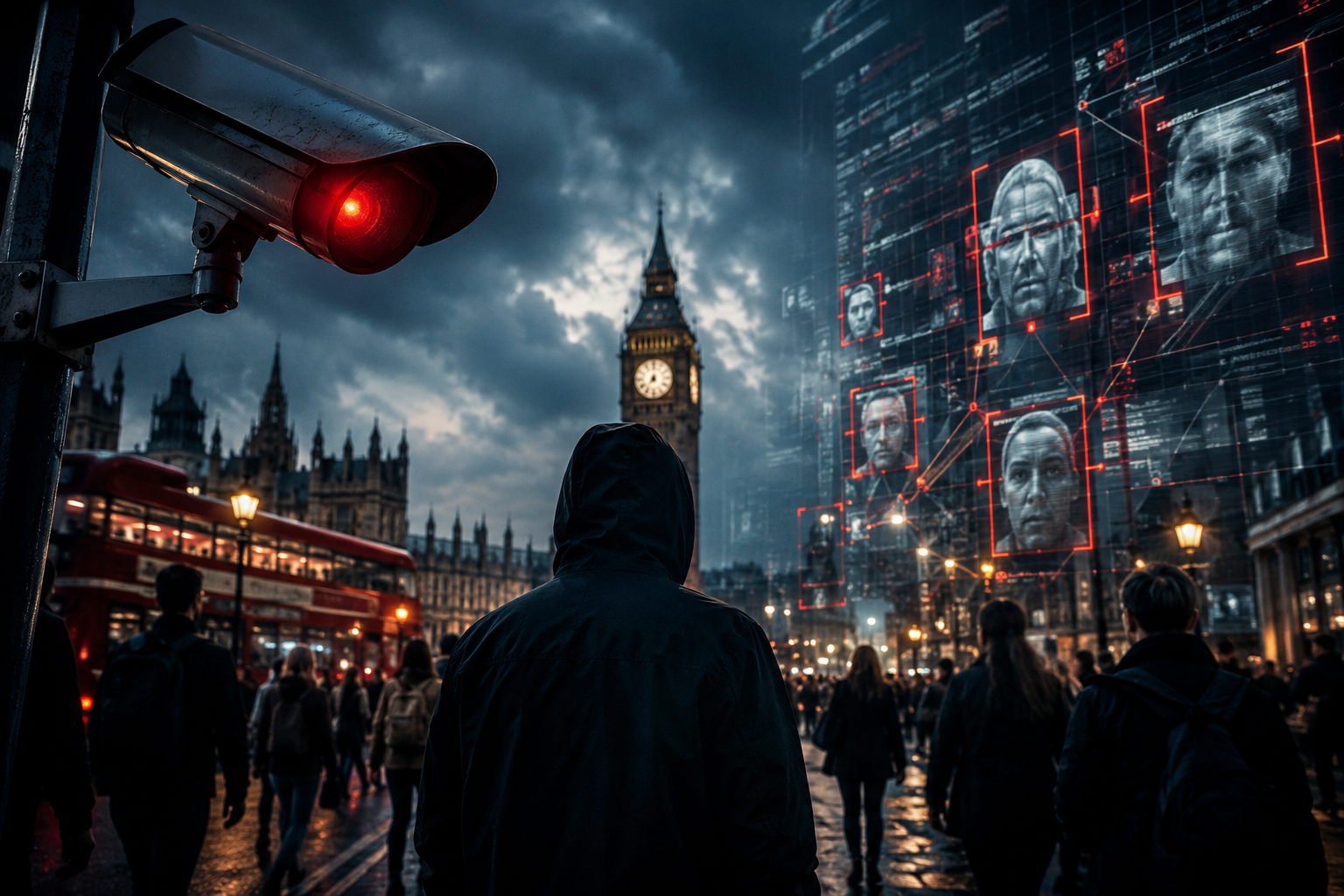
The AI Surveillance Expansion That Is Changing Britain In Real Time
Why Millions Of Britons Suddenly Fear They Are Being Watched Everywhere They Go
Britain’s Rapid Facial Recognition Expansion Has Triggered Fears Of A Permanent AI Surveillance Era
The cameras are no longer hidden.
They sit on police vans, scan crowded streets, watch transport hubs, monitor shopping districts, and process thousands of faces every hour. Most people walk past them without fully understanding what is happening in real time.
That is precisely why the backlash is growing.
Britain’s expansion of live facial recognition technology has suddenly become one of the country’s most emotionally charged political arguments. Supporters call it the future of policing. Critics call it the slow construction of an AI-powered surveillance state.
The technology is already spreading rapidly across England and Wales. Police forces are increasing deployments, government ministers are openly backing wider expansion, and court rulings have strengthened the legal position of law enforcement agencies using the systems.
But something deeper is now happening beneath the surface.
The public debate is no longer only about crime.
It is becoming a wider argument about freedom, trust, power, privacy, and whether modern Britain is entering an era where citizens are treated as permanently observable.
The emotional intensity surrounding the issue reflects a much broader fear already visible across the growing crisis of trust inside Western politics.
The Technology Is Expanding Faster Than Most People Realise
Live facial recognition systems work by scanning faces in public spaces and comparing them against police watchlists in real time.
Supporters argue the systems help police identify wanted criminals, violent offenders, and missing persons within seconds. The Metropolitan Police has described the technology as a major breakthrough for modern policing, comparing its long-term significance to fingerprinting.
The scale of deployment is growing rapidly.
In London alone, they have already scanned millions of faces. Some deployments reportedly process thousands of faces every hour. More police forces are adopting mobile systems, smartphone-based facial recognition tools, and expanded AI-assisted identification systems.
Government figures have openly defended wider rollout plans.
The argument from ministers is brutally simple: if the technology helps stop violent offenders, terrorists, or repeat criminals, then refusing to use it would itself become politically difficult to justify.
That framing is powerful because it pushes critics into an uncomfortable position. Nobody wants to appear soft on public safety. But opponents believe that is precisely why facial recognition expansion is politically dangerous.
Once security arguments normalise surveillance systems, they rarely shrink.
They expand.
The Real Fear Is Not Cameras — It Is Permanent Biometric Tracking
Most people are already used to CCTV.
Britain has lived with camera surveillance for decades. But facial recognition changes the psychological meaning of surveillance entirely because the system no longer merely records activity.
It identifies people.
That distinction matters enormously.
Critics argue that facial recognition transforms ordinary public life into a form of passive biometric monitoring. Walking through a shopping district, attending a protest, entering a train station, or simply existing in a public space can potentially become a data event processed by AI systems.
That is why the language around the issue has become increasingly dramatic.
Civil liberties groups have warned about “mass surveillance", “digital policing overreach", and even “panopticon-style” state visibility. Parliamentary criticism has intensified around fears that facial recognition could undermine freedom of assembly and public anonymity.
The deeper anxiety is psychological as much as political.
People behave differently when they believe they are constantly observable.
That concern fits a wider pattern already visible across the growing collision between AI, trust, and social control.
The misidentification problem has made the backlash more emotional.
The expansion debate became significantly more volatile after multiple cases emerged involving alleged false identifications.
Several people have publicly claimed that facial recognition systems used in retail and policing contexts incorrectly flagged them. Some described humiliation, emotional distress, or public confrontation after systems mistakenly linked them to criminal activity.
That matters because public tolerance for surveillance often collapses once ordinary people feel personally vulnerable to technological error.
The political danger for the government is obvious.
If facial recognition remains associated with stopping dangerous offenders, public support stays relatively strong.
If the technology starts to associate innocent people with being stopped, scanned, misidentified, or publicly embarrassed, the emotional tone changes rapidly.
The argument then stops being theoretical.
It becomes personal.
That emotional shift is one reason the surveillance debate increasingly overlaps with wider concerns about AI systems making high-impact decisions without sufficient human accountability.
Why Keir Starmer’s Government Is Walking Into A Political Minefield
The political timing could hardly be more sensitive.
Britain is already experiencing deep public distrust around institutions, policing powers, online speech regulation, protest laws, immigration tensions, and the expanding role of technology in everyday governance.
Facial recognition technology directly addresses those anxieties.
For critics of Keir Starmer’s government, the expansion of AI-assisted surveillance fits into a larger narrative: a Britain becoming more centralised, more monitored, and more technologically intrusive under the language of security and efficiency.
Supporters see the opposite.
They argue that modern crime increasingly requires modern policing tools and that refusing to use AI-assisted identification systems while criminals exploit technology would itself be irresponsible.
That division explains why the issue has become politically explosive.
Both sides believe they are defending freedom.
The court victories have not ended the argument.
Recent legal rulings have strengthened the position of police forces deploying live facial recognition systems.
A major challenge against the Metropolitan Police failed after judges concluded the existing policy framework contained sufficient safeguards and legal clarity.
But legal victory does not automatically create public legitimacy.
In fact, court approval may intensify political pressure because it removes one of the major barriers slowing deployment.
Critics now fear facial recognition could expand rapidly before Britain establishes a unified national legal framework governing biometric surveillance. Watchdogs have already warned that oversight structures are lagging behind the speed of adoption.
That gap is becoming one of the central arguments in the backlash.
The technology is advancing faster than democratic consensus.
The Bigger Question Britain Cannot Avoid Forever
The facial recognition debate is ultimately becoming a referendum on what kind of society Britain wants to become in the AI era.
That is why the issue feels bigger than policing.
Modern AI systems can already identify faces, analyse behaviour patterns, process crowds, map movement, and integrate with enormous data systems. Critics fear that the long-term trajectory could eventually normalise continuous state visibility in public life.
Supporters argue that those fears are exaggerated and that democratic safeguards, courts, and public scrutiny remain intact.
But the emotional momentum behind the backlash shows something important.
A growing number of people no longer believe technological power automatically arrives with sufficient restraint.
That distrust is spreading across politics, policing, technology, and institutions more broadly.
And once a population begins to fear that surveillance expansion is becoming permanent rather than temporary, the argument stops being about cameras.
It becomes about power itself.
